5 Reasons Your Music Gets Overlooked by Bloggers Even When the Song Is Good
“Music Promotion Is Not Optional” / “Treat Your Artist Brand Like a Company”
A good song is not always enough to earn a music blog feature.
That can be difficult for independent artists to hear, especially when so much emphasis is placed on making better music. But music bloggers, independent curators, playlist editors and online publications often receive far more submissions than they could realistically cover. When several songs are equally strong, presentation becomes part of the decision. A curator is not only evaluating whether your song sounds good. They are also asking themselves a much more practical question:
How easy will this artist be to feature?
If a writer has to chase you for an artist biography, search social media for usable photographs, decipher your lyrics, request an MP3 or send multiple emails just to confirm your release date, your submission has already created additional work. Meanwhile, another artist may have provided everything needed in one organised package. That artist becomes easier to cover.
Getting featured on music blogs is therefore not only about making great music. It is also about giving editors, writers and curators the information and assets they need to transform your release into an article, social media post, playlist placement or editorial feature. And if you already have the music and press materials ready but need help putting your release in front of relevant publications, Late9Plug’s Blog Placement Campaign is built specifically for artists seeking targeted editorial exposure.
If your music is strong but your submissions keep getting overlooked, one of these five mistakes could be holding you back.
1. You Submitted Your Song Without a Press Release or Track Description
Sending a song with no context is almost like submitting it naked.
A music blogger can hear the production, melody, instrumentation and vocal performance, but listening alone does not necessarily reveal the complete story behind the record.
What inspired the song?
What does the title mean?
Was it based on a personal experience?
Is it part of an upcoming EP or album?
Who produced the record?
Was there something unusual about the recording process?
What emotion or idea were you trying to communicate?
These details matter because a music writer needs more than an opinion about whether a song sounds good.
A writer needs a story.
Imagine two artists submit equally impressive songs.
The first sends nothing except a Spotify link.
The second sends the song alongside a concise description explaining that the record was written after the end of a seven-year relationship, recorded inside the artist's childhood bedroom and eventually inspired an upcoming EP.
The second submission immediately gives the writer an editorial direction.
That matters.
At minimum, every serious music submission should include a short track description explaining what the song is about, how it came together and anything noteworthy about the release.
Ideally, you should also prepare a proper music press release.
A good press release does not need exaggerated language claiming that your song is the next global anthem. It should simply give writers useful information they can build upon. Do not wait for the publication to contact you asking for additional details. By the time you respond hours or days later, the editor may already be working on several other submissions.
Make the story available immediately.
2. You Don't Have Professional Artist Photos
Music publications are visual platforms too.
When a blogger publishes 300, 500 or 800 words about an artist, they usually need imagery to accompany the article.
A strong artist photograph immediately improves presentation.
It also makes it easier for the publication to promote the feature through Instagram, Facebook, X, newsletters, homepage banners and other visual channels.
Every independent artist should therefore have at least three to five high-resolution promotional photographs available for press use.
Those photographs do not necessarily have to come from an expensive professional photoshoot.
They simply need to feel intentional.
Good lighting, thoughtful composition, proper resolution, strong styling and a recognisable visual identity can go a long way.
What usually does not help is sending:
Blurry screenshots
Heavily compressed Instagram downloads
Poorly cropped photographs
Promotional flyers instead of clean artist photos
Random selfies
Images covered with text
Low-resolution photographs that become pixelated on desktop screens
Remember that your photograph will appear on somebody else's website.
The publication wants visuals that make both you and their platform look professional.
There are thousands of talented artists releasing music every week.
Making a great song does not exempt an artist from building a strong visual identity around it.
Your sound captures attention.
Your visuals help people remember you.
3. You Didn't Include the Lyrics
If your song contains vocals, include the official lyrics with your music submission.
It is an extremely simple thing to provide, yet many artists overlook it.
Music writers frequently analyse specific lyrics when discussing storytelling, songwriting or the emotional meaning behind a song.
Sometimes one line can become the foundation of an entire paragraph.
Without official lyrics, however, the writer may have to replay sections of the track repeatedly just to understand exactly what you are saying.
That creates unnecessary friction.
The problem becomes even more noticeable when the song includes:
Heavy vocal processing
Layered harmonies
Background vocals
Fast rap delivery
Unconventional pronunciation
Multiple languages
Whispered vocals
Distortion or vocal effects
A music blogger should not need to become an audio detective before writing your feature.
Send the lyrics.
They can be included directly inside your electronic press kit, attached as a PDF or Word document, or added neatly to your press materials.
The format is less important than making the information available.
Official lyrics also help the writer better understand your artistic personality.
A line that sounds simple during the first listen can sometimes reveal considerably more meaning once it is read carefully.
Your goal should be to provide almost everything a writer could reasonably need before they ever have to ask for it.
4. You Respond Too Slowly During Your Music Promotion Campaign
Responsiveness matters far more than many artists realise.
Music bloggers and independent curators are often balancing dozens of submissions alongside writing articles, updating websites, managing social media, conducting interviews and answering emails.
Some run publications full-time.
Many do not.
A significant number of independent music blogs are operated by editors and writers who also have completely separate jobs and responsibilities.
Their time is limited.
If a blogger emails you requesting a photograph, release date, quote, production credit or missing piece of information, your response time can influence whether the article gets published that afternoon, several days later or potentially not at all.
During an active music release campaign, your inbox should become part of your marketing strategy.
You do not need to watch your email every minute.
But if you are actively pitching your music to blogs, curators and publications, regularly checking your messages makes sense.
Whenever possible, reply within a few hours.
If you can respond within an hour, even better.
A curator should not have to send several follow-up messages just to finish promoting your music.
Artists who communicate clearly and respond quickly are easier to work with.
And editors remember artists who are easy to work with.
That relationship can become especially valuable when you release your next song.
One blog feature is useful.
Developing lasting relationships with writers, curators and publications that genuinely appreciate your music can be far more valuable over time.
5. You Didn't Provide an MP3 and a Proper Streaming Link
Make listening to your music effortless.
A professional music submission should include a direct streaming link and, when appropriate, a downloadable MP3.
Different publications have different workflows.
Some bloggers prefer Spotify.
Others may use SoundCloud, Apple Music, Bandcamp or YouTube.
Some writers download music for offline listening while preparing an article.
Others may need the audio file for internal review.
Providing both a reliable streaming link and an MP3 gives the publication options.
For most press submissions, an MP3 is more practical than a WAV because the file size is considerably smaller.
You can still keep your WAV files available for radio stations, DJs, mastering engineers and other professional situations where lossless audio may be required.
For regular editorial submissions, however, sending an enormous WAV file is usually unnecessary.
Your streaming links should also work immediately.
Avoid sending:
Expired transfer links
Private folders requiring manual approval
Broken SoundCloud links
Locked cloud folders
Links requiring someone to create an account
Complicated folders containing dozens of unrelated assets
Every unnecessary click creates another opportunity for someone to abandon your submission.
The best music submissions feel almost frictionless.
Click the link.
Hear the song.
Understand the story.
Access the press materials.
Start writing.
That should be the experience.
Your Music Submission Should Feel Complete
Think about your submission as a professional media package, not simply a song link.
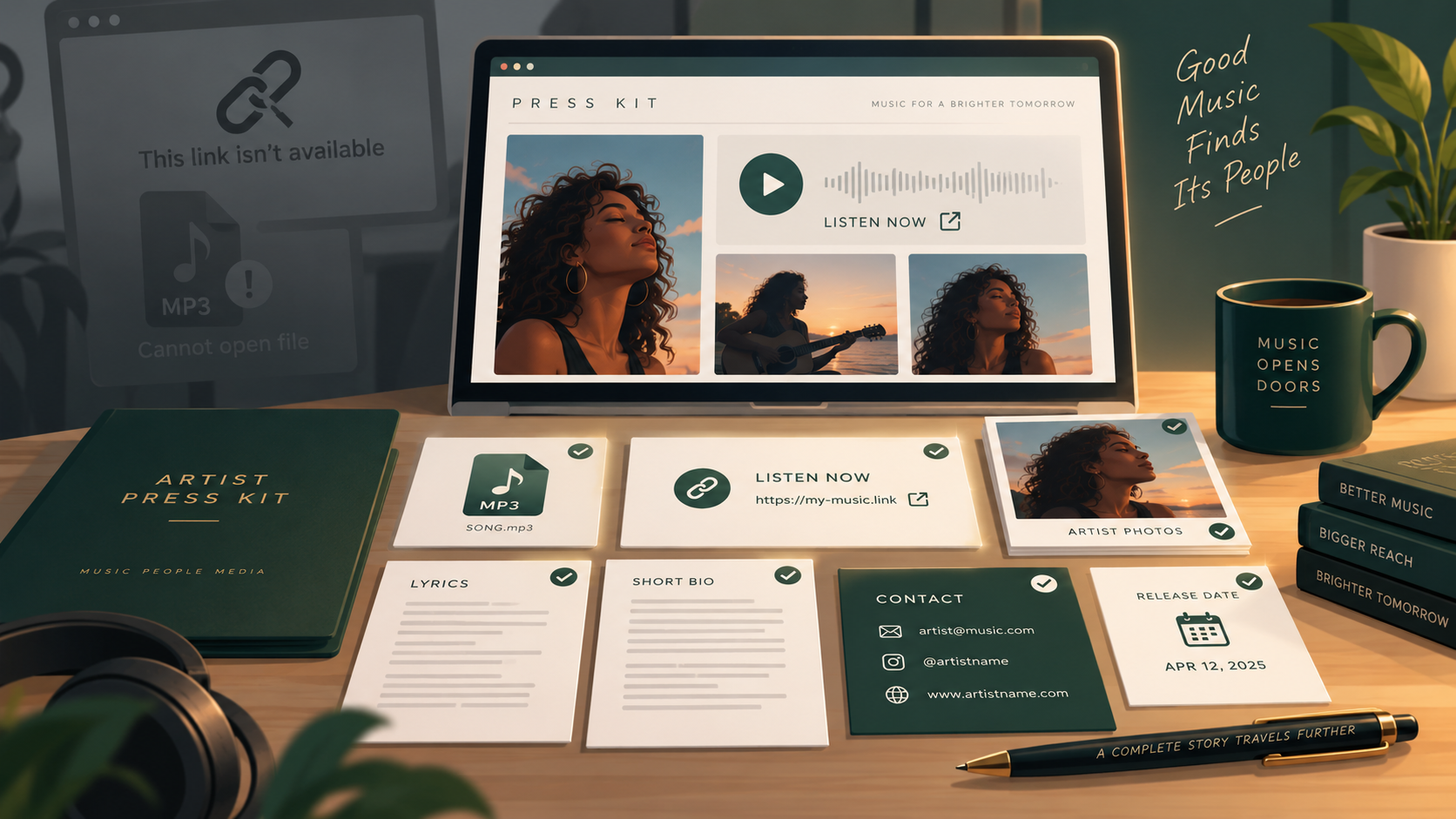
A curator should ideally open your email or submission and immediately find:
The song and working streaming link
A downloadable MP3
A concise track description
A professional press release
Official lyrics
Three to five high-resolution artist photographs
A short artist biography
Release date
Producer and songwriter credits
Relevant social and streaming links
Your contact information
The easier you make the editorial process, the easier you make it for somebody to say yes.
There is an extraordinary amount of good music being released every day.
That means sounding good is only the beginning.
Professionalism, preparation and communication can be the difference between an artist who gets heard and an artist who actually gets featured.
Want More Music Blog Coverage? Pitch Strategically
Even with excellent press materials, artists still need to identify publications that genuinely fit their sound and reach the right editors.
Randomly emailing hundreds of blogs is rarely the smartest approach.
Targeted music promotion usually works better because the publication, genre, audience and release need to make sense together.
For artists looking to increase their editorial reach, Late9Plug’s Blog Placement Campaign helps connect releases with music blogs and editorial platforms as part of a more structured promotional strategy.
Learn more about Late9Plug Blog Placement:
https://www.late9plug.com/blog-placement
Strong music remains the foundation, but music also needs proper positioning. Your press materials, imagery, story, communication and pitching strategy all work together. Do not send a curator half of what they need and expect them to assemble the rest of your campaign for you.
Send the song. Send the assets. Send the context. Send the complete story.
Featured
The Late9Plug BYLINE Blog Feature Campaign is designed for independent artists who want professional music press coverage, stronger artist visibility, improved Google search presence, and credible editorial content surrounding their latest release.
After reviewing your music, Late9Plug matches your single, EP, album, or music project with relevant independent music blogs based on genre, audience, editorial direction, and campaign compatibility.
Your release receives a minimum of 5 confirmed blog features, including placement through at least 2 higher-reach publishing partners within our available network.
Unlike mass music-submission services, Late9Plug focuses on targeted editorial placement. Each campaign is reviewed before activation, helping connect your music with publications that actually cover artists within your sound and niche.
Includes:
Minimum 5 confirmed blog features
Minimum 2 High-Reach Blog placements
Dedicated artist/release coverage
Genre-targeted publication matching
Artist biography and release information
Streaming and social links
SEO-focused online visibility
Published article URLs delivered after campaign
Singles, EPs and albums accepted
Campaign review before activation
Best for: emerging artists, debut campaigns, release-week publicity, building an EPK, strengthening Google results, and establishing an initial digital press footprint.